How you ask questions shapes what Q can find for you. This page walks through several approaches for structuring an analysis through conversation, from a novice-friendly starting point to more deliberate inductive, deductive, and abductive strategies.
New to qualitative analysis?
Ask Q directly: "I am new to qualitative analysis, can you suggest some initial questions to explore my data?" If you didn't add your research questions to the project description during setup, include them in your prompt so Q can tailor its suggestions. Recommendation: if you're just starting out, use Guided Conversational Analysis - it structures this process for you.
As you work with Q, you'll develop a feel for which questions yield meaningful insight, and framing your own queries will start to feel intuitive.
Inductive approach: from descriptive to conceptual
Start with the data itself and let patterns emerge, moving gradually from description to more abstract concepts and relationships.
- Start small. Select a focused subset - say, five interviews - so you can learn what each respondent said about your topic before scaling up.
- Ask descriptive questions, such as "What benefits and challenges have been mentioned?" You don't need to add "as mentioned by the respondents" - Q's answers are derived directly from your uploaded data, so there's no risk of it fabricating findings ("hallucinating"). If a question is unrelated to your dataset, Q falls back on its general training knowledge instead.
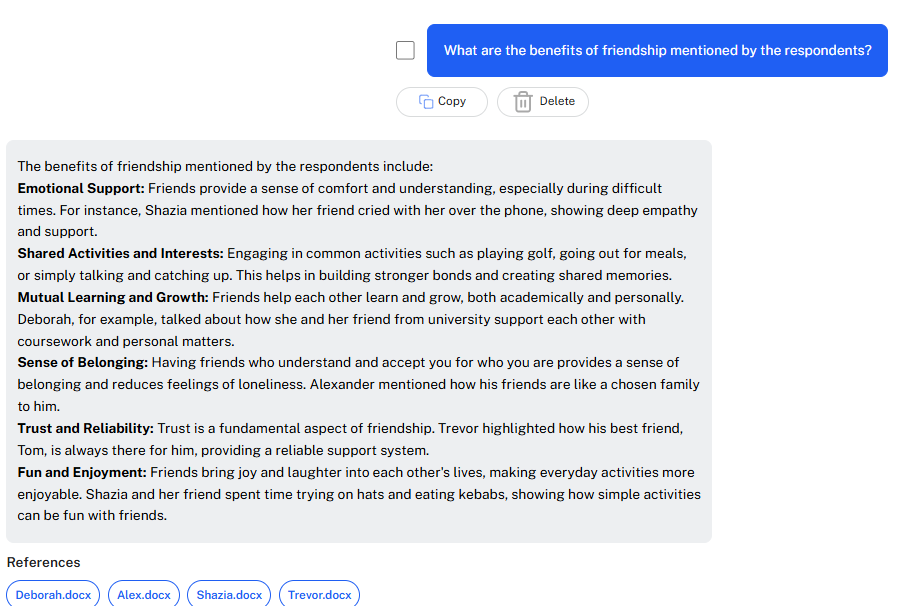
- Identify similarities and differences across participants, optionally using profile variables such as gender, age, or education - for Word/PDF data, activate these as filters first; for Excel data, reference them directly in your prompt.
- Group and label similar responses under higher-order categories (for example, grouping benefits into "Professional Development" or "Emotional Well-Being").
- Relate and contextualize - once you have concepts and sub-concepts, explore how they connect ("How does attitude X influence user behaviour?"), including across different documents.
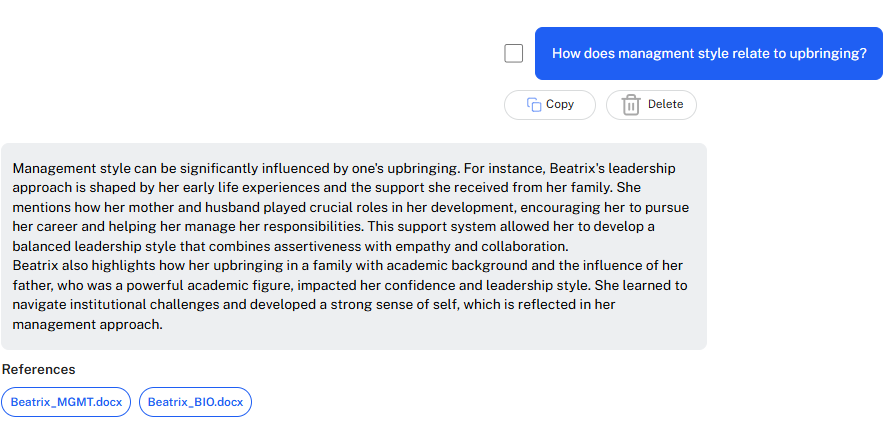
Inductive analysis surfaces new patterns and relationships that can later inform a broader, more structured deductive pass.
Deductive approach: from conceptual to descriptive
Start with existing concepts or hypotheses and examine whether and how they appear in the data.
- Define starting concepts or hypotheses. Ask and validate - "Do all respondents mention this specific concept?", or provide a framework directly: "Here are seven leadership styles [define them]. Which of them are described by the respondents?"
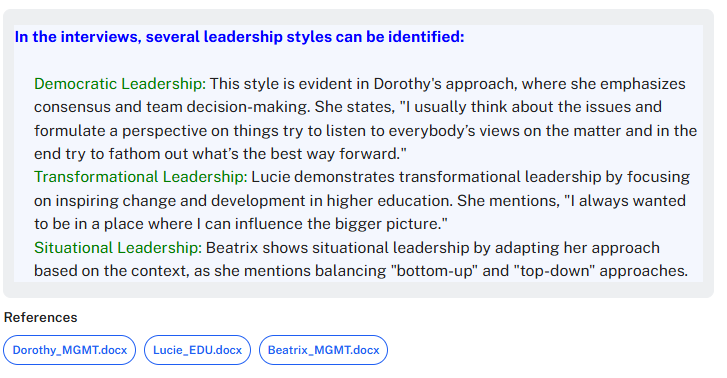
- Drill down into specific examples to understand and explain your findings.
- Group-level analysis - use profile variables as filters, or ask directly ("Is leadership style related to different age groups?").
Deductive analysis lets you test predefined ideas within your data while staying flexible enough to refine or expand them based on evidence.
Abductive analysis: when you find the unexpected
Abductive reasoning blends inductive and deductive thinking to generate the most plausible explanation for a surprising or puzzling observation - the approach Charles Sanders Peirce described as forming a reasonable hypothesis to make sense of something unexpected. It's particularly useful when a finding doesn't fit your assumptions, when you want to bridge data and theory, or when you need a flexible, iterative way to understand something complex.
- Ask exploratory questions to probe the observation - "Why might respondents with similar experiences express contrasting emotions?"
- Generate hypotheses with Q - plausible explanations grounded in the data and your own domain knowledge.
- Iterate and refine, moving between data and emerging hypotheses with follow-up questions that confirm, sharpen, or challenge them.
- Validate with data - check whether an explanation holds across other subsets or respondent groups.
For a fuller walkthrough - including why this feels a lot like detective work - see Abductive Analysis: If You Find the Unexpected on the QInsights blog.
Querying all data vs. subsets
Asking a question across a large dataset (say, 30 interviews) tends to produce broad, generalized answers. This isn't a quirk - it's how large language models handle scale:
- Summarization bias - the model is optimized to distil large volumes of information into concise responses, blending points together.
- Complexity dilution - with more data, the model prioritizes comprehensiveness over depth, so nuances can be overshadowed by dominant themes.
- Pattern obfuscation - heavy synthesis can mask the diversity of individual data points, making distinct patterns harder to see.
Narrowing to a targeted subset that matches specific sample criteria produces more relevant, detailed answers: patterns become more apparent, and responses can explore nuance rather than generalize across everything at once.
Use profile variables and filters - demographics, document type, collection date - to build subsets aligned with your research questions, and work dialogically: ask broad questions first to get a sense of the data, then follow up with narrower, targeted ones as your understanding sharpens.
Next steps
See Analytic Questions and Templates for ready-to-adapt prompt patterns - follow-ups, comparison tables, relational and causal questions, and validating your own synthesis.