
When Consent Is Not Enough: Data Anonymization in AI-Assisted Research
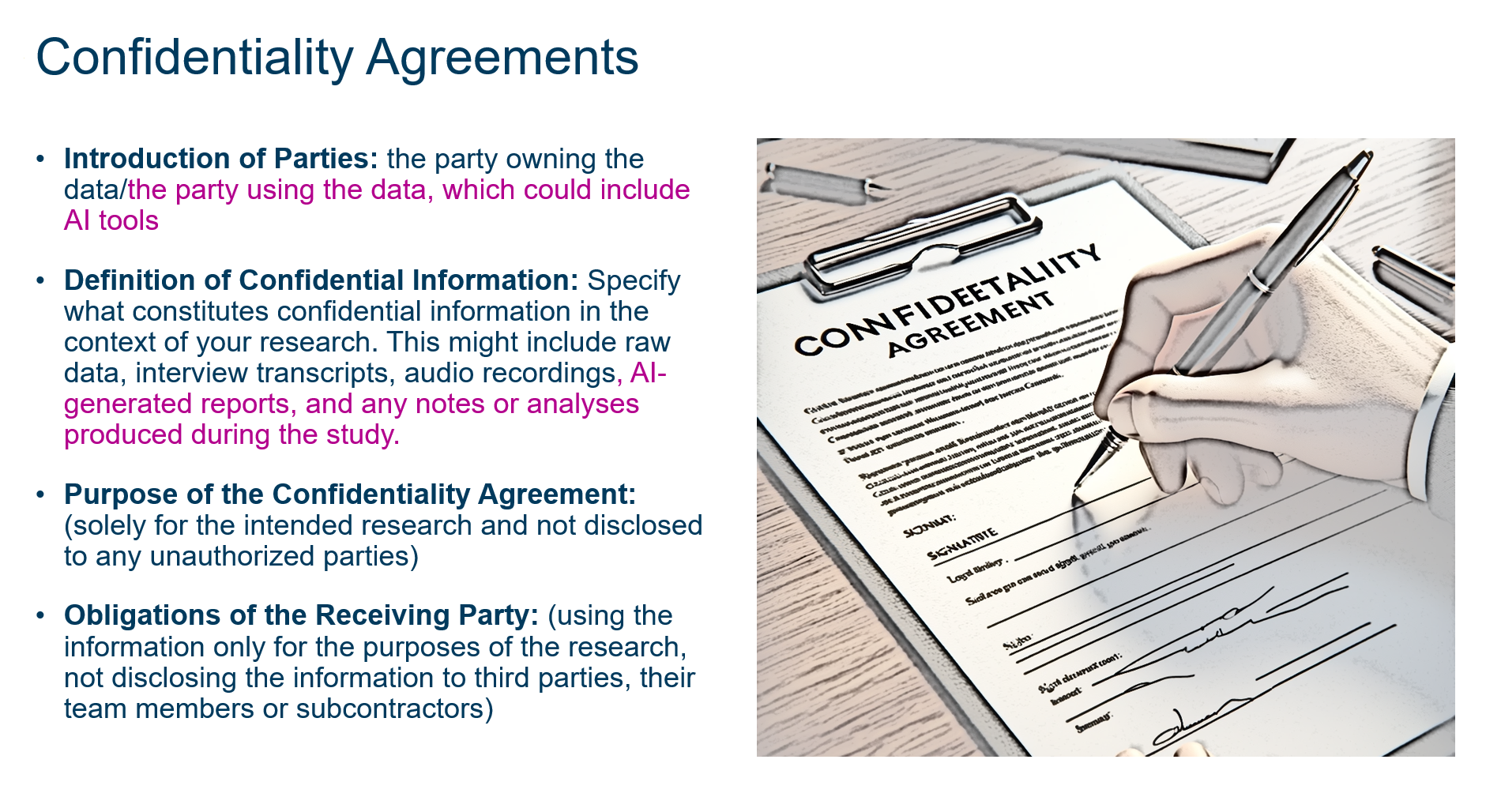
There is a common assumption in current discussions about AI in qualitative research: if participants have consented to take part in a study, their data can be used for analysis — including analysis with AI tools.
That assumption is understandable. Informed consent is central to research ethics. Researchers who take consent seriously are doing something important.
But consent is not a blanket permission slip.
When qualitative data is processed through AI systems, especially cloud-based platforms, researchers need to consider more than participant consent. They also need to think about privacy law, data protection obligations, third-party processors, international transfers, and the methodological suitability of the tools they use.
This matters because qualitative data is rarely just "text." Interview transcripts, focus group recordings, field notes, and open-ended responses often contain names, places, roles, organizations, dates, relationships, and contextual details that can make people identifiable — even when obvious identifiers have been removed.
Consent is part of responsible research. It is not the whole story.
What Privacy Law Actually Requires
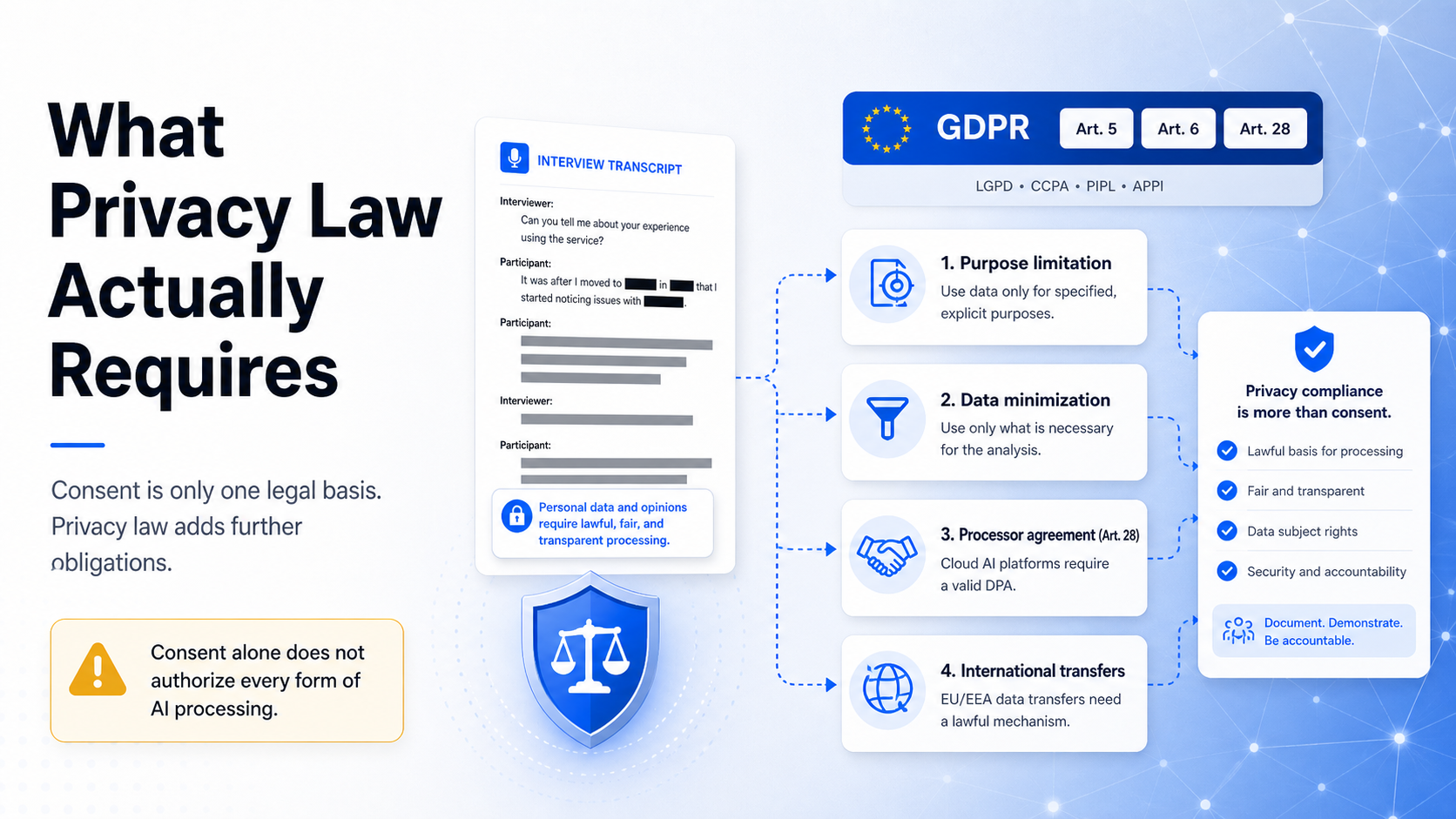
The General Data Protection Regulation (GDPR), which governs the processing of personal data in the European Union and European Economic Area, does not treat consent as a universal authorization. Consent is one of six legal bases for processing personal data under Article 6. Even where consent applies, it sits alongside other obligations that directly affect how research data can be handled.
The principle of purpose limitation requires that personal data be collected for specified, explicit, and legitimate purposes. A consent form that refers broadly to "research purposes" or "data analysis" does not automatically mean that identified transcripts can be uploaded to a third-party AI platform. The processing purpose needs to be specific. In many studies, participant information sheets and consent forms were written before AI-assisted analysis was part of the research design.
The principle of data minimization requires that personal data be adequate, relevant, and limited to what is necessary for the purpose of processing. If a research question can be addressed using anonymized or pseudonymized data, uploading fully identified transcripts may be difficult to justify — even when participants have consented.
Third-party processor obligations add another layer. When a researcher uploads data to a cloud-based AI platform, that platform may become a data processor. Under GDPR, this requires a Data Processing Agreement between the controller, usually the researcher or institution, and the processor. Consumer-facing AI tools are generally not designed to function as research data processors in this sense, and many researchers using them have not established the necessary contractual basis.
International transfers also matter. Many AI platforms are operated by US-based companies. Sending personal data outside the EU/EEA requires a valid legal mechanism, such as an adequacy decision, Standard Contractual Clauses, or Binding Corporate Rules. Since the Schrems II ruling, these transfers require active scrutiny rather than assumption.
GDPR is the framework most familiar to European researchers, but similar requirements exist elsewhere. Brazil's LGPD, California's CCPA, China's PIPL, and Japan's APPI each impose their own obligations. International research collaborations may therefore involve more than one regulatory framework at the same time.
The practical implication is simple: researchers cannot rely on consent alone when using AI-assisted analysis tools.
Why Anonymization Matters
Anonymization offers a practical starting point.
Data protection law applies to personal data. If data is genuinely anonymized — meaning that individuals can no longer be identified directly or indirectly — it falls outside the scope of data protection law. This is not a workaround. It reflects the basic purpose of privacy protection: protecting people.
For qualitative researchers, anonymization before upload can substantially reduce legal and ethical risk. It allows researchers to retain the analytical value of their data while reducing the likelihood that participants can be identified in downstream processing.
But anonymization in qualitative research is not a simple search-and-replace task.
Names are only the beginning. Qualitative data often contains indirect identifiers: job roles, organizational affiliations, locations, rare experiences, family relationships, dates, project names, institutions, and combinations of details that become identifying in context. What counts as identifying information depends on the research setting, participant population, topic sensitivity, and likely audience.
A senior manager in a small organization may be identifiable by role alone. A participant in a rare medical pathway may be identifiable through a combination of age, location, and treatment history. A community worker in a specific region may be identifiable even after their name has been removed.
This is why anonymization requires judgment. It is both a technical and methodological task.
Privacy Compliance Is Not the Same as Methodological Quality
Anonymization addresses one part of the problem. It reduces privacy risk. But it does not automatically make an AI tool suitable for qualitative analysis.
General-purpose AI tools were not designed for qualitative research. They often lack audit trails. They do not reliably connect interpretive claims to specific passages in the data. They may generate fluent summaries without making clear how those summaries were derived. They do not preserve the researcher's interpretive authority unless the analysis environment is designed to support that role.
This distinction matters.
Privacy compliance asks: may this data be processed in this way?
Methodological integrity asks: does this tool support rigorous, transparent, evidence-linked qualitative analysis?
Both questions are necessary. They are not interchangeable.
Researchers need tools that protect participant data and support defensible interpretation. This means anonymization, secure processing, evidence links, traceability, and workflows that keep the researcher actively involved in the analysis.
Why QInsights Includes an Anonymizer
QInsights was built for AI-assisted qualitative analysis where the researcher remains in control. It is not designed as a one-click summary tool or a generic chatbot interface. The goal is to support structured, evidence-linked analysis of interviews, focus groups, open-ended survey responses, and other forms of unstructured research data.
The QInsights Anonymizer is part of that broader approach.
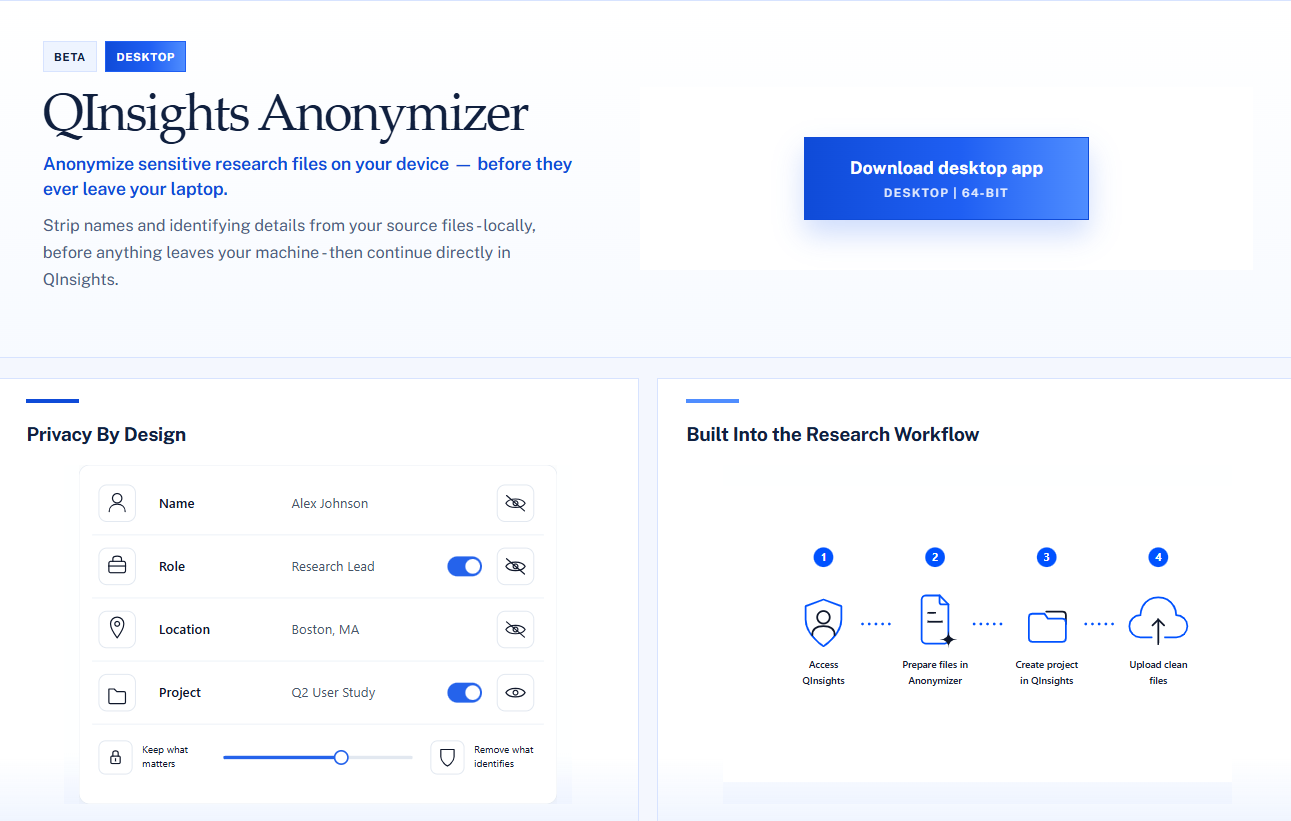
It is a desktop tool that processes transcripts locally, before anything is uploaded into QInsights. It helps identify and anonymize up to 27 categories of personal identifiers across English, German, and Spanish. This includes direct identifiers such as names and contact details, but also contextual identifiers that may matter in qualitative research.
The point is not to remove all responsibility from the researcher. Anonymization still requires review and judgment. The point is to give researchers a practical, research-oriented tool that supports responsible preparation of data before AI-assisted analysis begins.
For us, anonymization before upload is not an optional add-on. It is part of the baseline for responsible AI-assisted qualitative research.
A Practical Baseline for AI-Assisted Research
AI can support qualitative research in meaningful ways. It can help researchers explore patterns, compare perspectives, follow analytical leads, and work more efficiently with complex material.
But this only works responsibly when the infrastructure supports the standards of research.
Consent matters. But consent alone is not enough.
Before uploading qualitative data into any AI system, researchers should ask:
- Has the data been anonymized or pseudonymized where possible?
- Is there a lawful basis for processing?
- Is the AI platform operating under an appropriate processor agreement?
- Are international data transfers addressed?
- Can the analysis be traced back to the underlying data?
- Does the tool support, rather than replace, the researcher's interpretive role?
These questions are not administrative obstacles. They are part of doing high-quality research in an AI-enabled environment. QInsights was built around this principle: AI should assist qualitative analysis without weakening privacy, transparency, or methodological rigor. The Anonymizer is one practical step in that direction. You find more information about the Anonymizer in the manual: Data Anonymizer tool.
Researchers with a QInsights account can access the Anonymizer as part of the platform. Free trial access is available here.