
AI Can Accelerate Qualitative Research, But Human Judgment Still Owns the Insight
AI is no longer a future question for qualitative research. It is already here. It is helping teams clean transcripts, organize interviews, summarize long discussions, detect early themes, and move faster from raw data to first understanding. For qualitative researchers, this is a real shift. Work that once took weeks can now be supported in days.
But speed is not the same as insight. At QInsights, we believe AI should help researchers move faster through the workflow, not replace the human judgment that gives qualitative research its value.
Qualitative research is conducted to understand people: to interpret emotion, contradiction, context, silence, hesitation, and meaning, and to transform messy human conversations into something we can learn from, derive decisions from, develop programs, products, interventions, whatever the reason was to conduct the research. That is where the boundary matters. AI can support the research process, but interpretation must remain human-led.
The Real Risk Is Not AI Usage. It Is Losing Nuance.
In qualitative research, the danger is not simply that AI may make a mistake. The deeper risk is that AI can make complex human data look too clean.
A transcript may contain frustration, hesitation, emotional tension, uncertainty, disagreement, or a small but important outlier. But when AI summarizes that conversation too quickly, the output can become polished and generic.
For example, an AI-generated summary might say:
Participants found the product useful and easy to use.
That may sound correct, but it may hide important details. Maybe one participant used the product daily but did not trust the brand. Another might have liked the feature but felt embarrassed using it in front of others. A small group may have shown strong emotional resistance that could affect adoption. Perhaps the real insight was not "easy to use," but "easy to understand, yet hard to trust."
That difference matters. This is why qualitative research cannot stop at summary. The value is not only in what people said, but in what their words reveal.
AI Is Excellent for Supporting the Workflow
There are many areas where AI can genuinely improve qualitative research. It can help researchers prepare faster, reduce repetitive manual work, make large volumes of qualitative data easier to explore, and give teams a first view of what may be happening inside interviews, focus groups, open-ended surveys, and research documents.
AI can support tasks such as:
- Transcript cleanup
- File preparation
- First-pass summaries
- Initial topic detection
- Speaker organization
- Early categorization
- Data navigation
- Quote discovery
- Research workspace organization
These tasks matter because they reduce friction. A researcher should not spend unnecessary time searching through messy files, manually organizing every transcript, or repeatedly formatting research material before analysis can begin.
This is where QInsights is designed to help. QInsights gives qualitative teams a structured workspace where research data can be uploaded, organized, summarized, filtered, analyzed, and explored with AI support. The goal is not to remove the researcher, but to give the researcher a stronger starting point.
But AI Should Not Be Treated as the Final Answer
The biggest mistake teams can make is treating an AI output as the conclusion. A summary is not an insight. A topic list is not a strategy. A sentiment label is not an interpretation. And a clean report is not automatically a truthful report.
Qualitative research is valuable because people are complex. Participants contradict themselves. They say one thing and mean another. They speak differently depending on context, emotion, culture, memory, and social pressure. AI often tries to make things coherent, but human behaviour is not always coherent.
That is why the researcher's role becomes even more important in an AI-assisted workflow. The researcher must ask:
- What is missing from this summary?
- What tension did the AI smooth over?
- Which voices are underrepresented?
- Which quote changes the meaning of the finding?
- Where is the contradiction?
- What does this mean for the client's decision?
This is where insight happens.
The Human Role Moves Higher in the Value Chain
AI does not remove the need for qualitative researchers. It changes where their highest value appears. The future of qualitative research is not about spending more time on manual formatting or repetitive data preparation. It is about spending more time on interpretation, synthesis, and advisory work.
Researchers will increasingly be valued for their ability to:
- Read between the lines
- Identify emotional patterns
- Understand outliers
- Explain contradictions
- Connect findings to business decisions
- Challenge shallow conclusions
- Translate research into strategic direction
This is the work AI can support but should not own. The strongest researchers will not be the ones who reject AI completely. They will be the ones who know how to use AI responsibly while protecting the craft of interpretation.
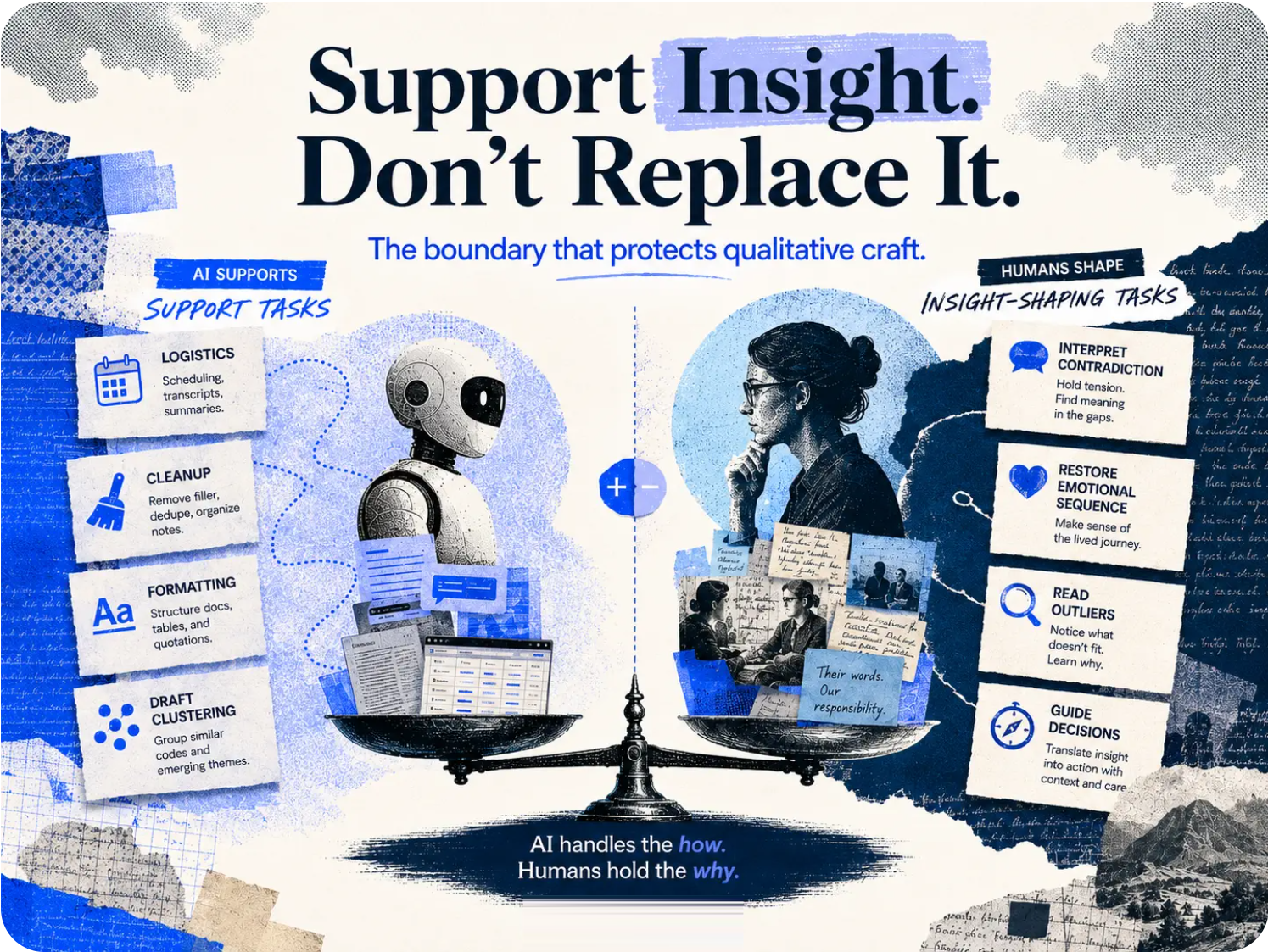
A Better Boundary: Support Insight vs. Shape Insight
At QInsights, we believe research teams need a simple rule: use AI for tasks that support insight and keep humans responsible for tasks that shape insight.
Support tasks include organizing, cleaning, summarizing, searching, filtering, and preparing data. Human-led tasks include interpreting meaning, explaining emotional tension, understanding context, evaluating contradictions, and deciding what matters strategically.
This boundary is important because not all research tasks carry the same level of responsibility. When AI helps prepare the work, it creates efficiency. When AI replaces interpretation, it creates risk. That is why human review should not be treated as a final checkbox. It should be part of the research method.
What This Means for Those who Commission Research
Knowing AI is in the loop, those who commission research want faster outputs, expect modern tools. They may even assume that AI can generate research findings instantly.
Above all, they still need confidence. They need to know that speed did not come at the cost of truth and to understand where AI helped and where human expertise shaped the final interpretation. This creates an opportunity for qualitative researchers to communicate their value more clearly.
A stronger message is:
We use AI to accelerate the research workflow, but human researchers remain responsible for interpretation, nuance, and strategic meaning.
That is a more modern, confident, and transparent position. It shows that the team is not resisting technology while also demonstrating an understanding of the limits of automation.
How QInsights Fits Into This Future
QInsights is built for this human-first AI research workflow. It helps qualitative researchers move faster through the heavy parts of the process while keeping the researcher in control of the final meaning.
With QInsights, teams can upload research files, organize data, explore summaries, run different types of analysis, filter by documents or speakers, and move from raw material to structured understanding more efficiently. But the purpose of QInsights is not to replace the researcher's judgment. The purpose is to make that judgment easier to apply.
AI can help surface patterns, while the researcher decides which patterns matter. AI can summarize what was said, while the researcher interprets what it means. AI can organize complexity, while the researcher turns complexity into direction.
That is the future we believe in: not AI instead of researchers, but AI with researchers.
Human-First AI Is a Competitive Advantage
The next generation of qualitative research will not be defined only by who uses AI. It will be defined by who uses AI with discipline.
Teams that use AI without human interpretation may produce faster outputs, but they risk losing the nuance that makes qualitative research valuable. Teams that combine AI speed with human judgment will be able to deliver faster, clearer, and more trustworthy insight.
That is the real advantage. AI can accelerate the workflow, but human judgment still owns the insight. And in qualitative research, insight is the product.