
Applied research · Leap Research
Moving from 1,000 user reviews to focused product priorities
The purpose of this story is to illustrate how QInsights can be used to conduct a thematic analysis of user reviews. T. S. Lim, Managing Partner at Leap Research, demonstrates the practical application of the platform using the Android version of Permata ME, a mobile-banking app by Permata Bank, as a case study.
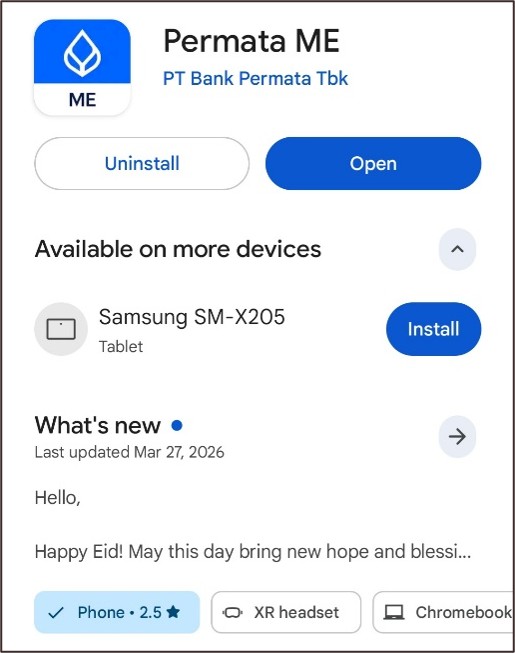
Permata Bank is the ninth-largest bank in Indonesia based on assets. At the time of the analysis, however, its Android mobile-banking app was rated poorly by users, with an average rating of only 2.5 out of 5. The rating made the dissatisfaction visible, but it did not explain the specific pain points behind it or indicate which problems should receive priority.
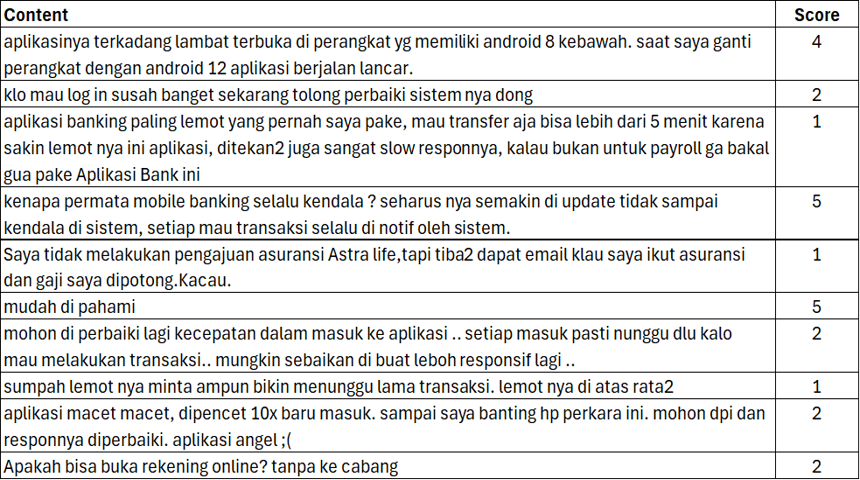
On 13 April 2026, Lim set out to show how QInsights could support the thematic analysis of user reviews. Leap Research extracted the 1,000 newest Google Play comments, spanning 17 January to 10 April 2026, and reviewed a sample of the raw comments before processing the full dataset. The comments provided the raw user accounts for the analysis. Below you see a sample of the data that were analysed.
The thematic analysis used the content of the comments rather than the star ratings. The low star rating signalled a problem, but star ratings alone do not tell product teams what to fix. The analytical task was therefore to move from a number to a diagnosis.
After uploading the CSV file to QInsights, he selected Guided Conversational Analysis and submitted the following prompt:
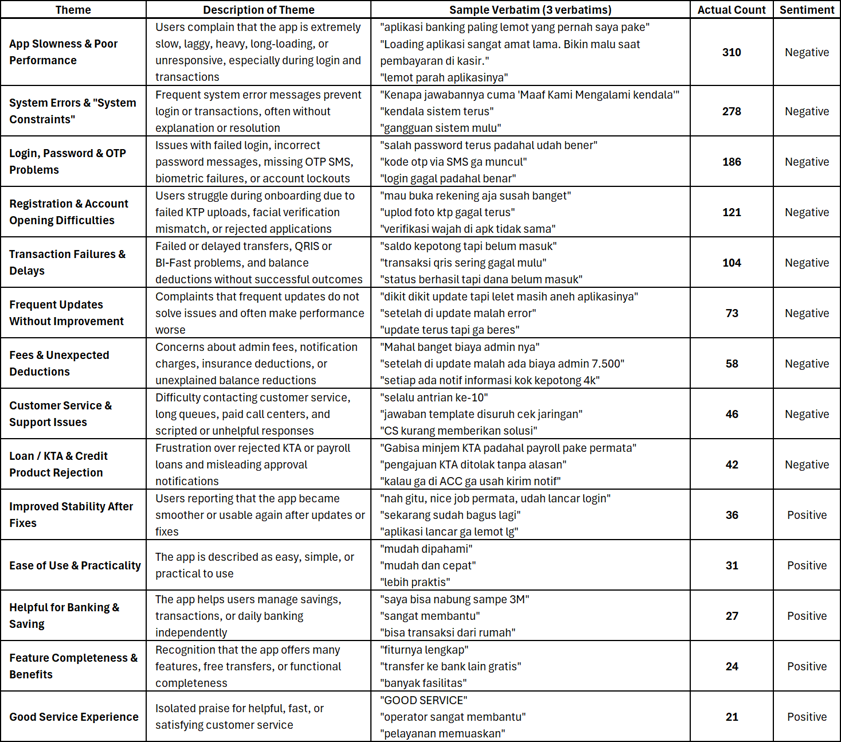
The key analytical insight was that more than 70% of all comments were concentrated in just three themes: app slowness and poor performance, system errors, and login, password and OTP problems. These were not scattered complaints. Together, they pointed to a structural reliability problem affecting the basic mobile-banking experience.
Positive feedback was also present, but it was fragmented and numerically small. Users mentioned improved stability after fixes, ease of use, practical support for banking and saving, feature completeness, and isolated good service experiences. The balance of the findings indicated that dissatisfaction was not driven by a rejection of the app concept or by a lack of features.
Users were not rejecting Permata ME as a concept. They were rejecting its unreliability.
The strategic priority was therefore not to add new features or rebrand the app, but to make it reliably stable. Once the core reliability issues were addressed, the existing feature set already positioned the app competitively. The fastest route towards rebuilding trust was to improve loading speed, eliminate system errors and make login and authentication dependable.
By using QInsights to listen across 1,000 user voices, the analysis moved beyond the “2.5-star” number towards a focused product-recovery strategy. For this kind of work, Lim describes QInsights not simply as an analytics tool, but as a qualitative reasoning layer between raw user voice and product decision-making.