
Best AI Qualitative Research Software in 2026: Listen Labs, QInsights, MAXQDA, ATLAS.ti and Other Tools Compared
Search for the best AI qualitative research software in 2026 and you will find increasingly long lists of platforms: Listen Labs, GetWhy, Outset, Strella, Conveo, MAXQDA, ATLAS.ti, NVivo, Dovetail, QInsights and many others.
There is a problem with these comparisons. These platforms do not all do the same job.
Some collect hundreds of AI-moderated customer interviews and automatically turn them into reports. Some are established qualitative data analysis environments designed for researchers working intensively with their own data. Some are research repositories. And a newer category uses generative AI to support researchers in analysing existing qualitative material.
Putting all of them into one ranking of “qualitative research software” is a little like comparing apples and bananas. Both are useful. But deciding that one is better because it has more of the characteristics of an apple does not tell you very much about the banana.
The distinction matters because software is beginning to shape expectations about what qualitative research itself should look like: more participants, faster interviews and increasingly automated analysis.
That may be exactly what some research teams need. It is however not the direction every qualitative study needs to take.
First: what do we mean by AI qualitative research software?
Listen Labs currently describes itself as an end-to-end AI research platform covering study design, participant recruitment, AI-moderated interviews and automated insight delivery. Its comparison of 14 “AI qualitative research” platforms places tools with quite different purposes into the same overall category.
Interestingly, other vendors draw the boundary differently. GetWhy describes GetWhy, Outset, Listen Labs, Conveo, Strella and Maze as AI user interview platforms.
That is a useful distinction.
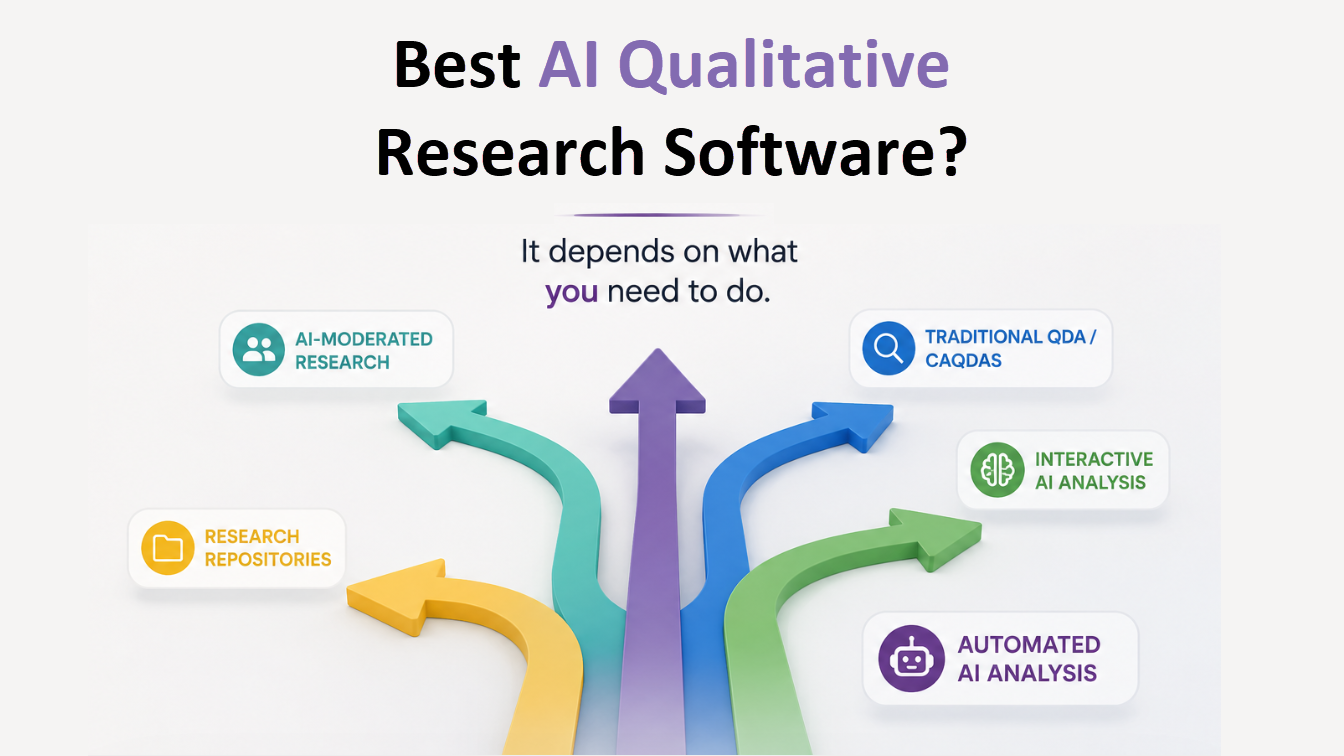
The current market can more meaningfully be divided into at least four categories.
| Category | Examples | Primary purpose |
|---|---|---|
| AI-moderated customer and user research | Listen Labs, GetWhy, Outset, Strella, Conveo | Collect large amounts of new customer or user data quickly through AI-moderated research |
| Qualitative data analysis software / CAQDAS | MAXQDA, ATLAS.ti, NVivo | Systematically organise and analyse qualitative and mixed-methods data |
| AI-assisted qualitative analysis | QInsights, Karl AI, CoLoop | Use generative AI to explore, question, compare and analyse qualitative data |
| AI-assisted coding and thematic analysis | HeyMarvin, Evidano, Skimle | Use generative AI to generate and apply codes, categories and themes to qualitative data |
| Research repositories and UX research platforms | Dovetail, Condens | Organise, analyse and share research knowledge across organisations |
These categories are not mutually exclusive. As platforms add new AI capabilities, their features increasingly overlap. The distinction reflects the primary research purpose and analytical workflow around which each platform is designed.
Nevertheless, the primary research problem these products are designed to solve remains an important distinction.
Listen Labs and AI-moderated research: a genuinely new category
Listen Labs, GetWhy, Outset, Strella and Conveo represent one of the most significant recent developments in research technology. They allow an AI moderator to conduct many interviews simultaneously.
Platforms like Listen Labs combines study design, participant recruitment from a large participant network, AI-moderated video, voice and text interviews, and automated analysis. A research team can move from a research question to findings extremely quickly.
That is a substantial capability.
For commercial customer research, product research, concept testing, brand research, advertising research and continuous customer feedback, the advantages are obvious. Instead of organising 20 interview appointments over several weeks, a company can potentially hear from hundreds of customers within a short period of time.
AI moderators can also do something human interviewers cannot: conduct many conversations simultaneously and consistently across languages and locations. This deserves to be recognised as a research category in its own right.
The difficulty begins when AI-moderated research at scale is presented as simply a faster and more scalable version of qualitative research as we have known it.
It isn't.
It creates a different type of research.
Is an AI interview the same as an in-depth qualitative interview?
AI interview platforms increasingly emphasise their ability to probe.
This is an important development. An AI interviewer is substantially more sophisticated than an open-ended survey question because it can respond to what a participant has said and generate a relevant follow-up.
A capable interview format
Having recently experienced a Listen Labs interview myself, I was impressed by how well some of the practical problems of AI interviewing have been addressed. Participants can hear or read a question, take time to think, and only start recording when they are ready. They decide when they have finished their response before moving on to the next question. This avoids some of the awkwardness I have experienced with other AI interviewing systems, where pauses can trigger the next question or participants have to formulate their response against a visible time limit.
But a well-designed interaction does not make an AI interview methodologically equivalent to an in-depth interview conducted by an experienced qualitative researcher.
The iterative logic of qualitative interviewing
There is another important difference that becomes visible not within one interview, but across a series of interviews. Qualitative researchers learn while interviewing. The tenth interview is rarely conducted with exactly the same understanding as the first. Even without formally beginning analysis between interviews, researchers notice patterns, discover ambiguities, realise that questions do not work as expected, identify issues they had not anticipated, and sometimes adjust what they ask next. In methodologies such as grounded theory, this iterative relationship between data collection and analysis is an explicit methodological principle.
If an AI interviewer conducts the same study with 100 participants, consistency can be a major advantage when the objective is to obtain highly comparable responses. But consistency and qualitative iteration are different research logics.
Human qualitative interviewing also involves more than generating an appropriate next question. Researchers establish rapport. They recognise hesitation and ambiguity. They decide when silence is productive. They notice when an apparently incidental comment may be more important than the participant realises. They may abandon part of the interview guide because the conversation has revealed something that changes their understanding of the phenomenon.
The interview itself is part of the interpretive research process.
Do qualitative researchers really need hundreds of interviews?
One of the strongest propositions behind AI-moderated research is scale. If interviewing becomes inexpensive and parallelisable, why speak to 20 people when you can speak to 200?
For some research questions, there are good reasons to do exactly that.
But this reasoning imports a quantitative assumption into qualitative research: more observations automatically produce better evidence.
Qualitative sample sizes are not simply smaller quantitative sample sizes. A qualitative researcher might conduct 15 narrative interviews, 25 stakeholder interviews, six focus groups or an intensive longitudinal study with ten participants.
Those numbers may be entirely appropriate.
- An evaluation team might deliberately select stakeholders representing different positions in a programme rather than seek hundreds of respondents.
- A healthcare researcher working with a rare patient population may have a small number of information-rich cases.
- A grounded theory researcher may use theoretical sampling, where decisions about whom to interview next are informed by the developing analysis.
- An ethnographic researcher may spend months studying a relatively small number of people in considerable depth.
In these contexts, 500 interviews would not necessarily produce a better study. They would simply produce more data.
The ability to collect more qualitative data should not be confused with a methodological requirement to do so.
The hidden consequence of scale: analysis has to become automated
There is another consequence of collecting hundreds of interviews. Someone has to analyse them.
If a platform conducts 300 interviews in a day, conventional researcher-led analysis quickly becomes impractical. The technological solution to the data-collection bottleneck therefore creates an analytical bottleneck.
The obvious solution is AI.
AI-interview platforms consequently do not stop at conducting interviews. They automatically identify topics and patterns, generate summaries and create outputs that research teams can use. At this scale, automation is not merely convenient. It becomes structurally necessary.
And for the research problems these platforms are designed to solve, that may be entirely appropriate.
But we should distinguish between automated synthesis of qualitative responses and researcher-led qualitative analysis. They are not necessarily the same analytical activity.
Automated themes are not the methodological gold standard
Generative AI is remarkably good at finding patterns in text. Give an LLM a collection of interview transcripts and it can summarise them, identify recurring topics, suggest themes, compare participants and retrieve illustrative quotations within seconds. That capability is enormously useful. But speed does not settle the methodological question. Qualitative analysis is not simply a process of finding the most frequently recurring ideas in a dataset and describing them accurately.
Researchers consider what is significant rather than merely common. They examine contradictions. They investigate negative cases. They compare contexts. They ask why apparently similar statements might mean different things. They develop interpretations and then return to the material to test them.
Most importantly, analysis changes as the researcher understands more.
- A first reading generates questions.
- Those questions lead back to the data.
- Unexpected evidence changes the interpretation.
- The revised interpretation generates another question.
This iterative movement between data, questions and developing understanding is fundamental to many forms of qualitative analysis.
An automated analysis that moves directly from transcripts to topics, themes and report may be useful, but it represents a different analytical model. For some research purposes, that is sufficient. For others, it is precisely the analytical work the researcher does not want to outsource.
MAXQDA, ATLAS.ti and NVivo solve a different problem
This is why comparisons between Listen Labs and established qualitative data analysis programs such as MAXQDA, ATLAS.ti and NVivo can be misleading.
These programs emerged from a very different research tradition.
Their purpose has historically been to give researchers tools for systematically working with qualitative material: coding, memo writing, retrieval, categorisation, comparison, visualisation and interpretation.
They are widely used in academic research, evaluation, healthcare, social science and mixed-methods research. Users of those platforms do not recruit hundreds of consumers and conduct interviews for you because that is not the problem they were designed to solve.
Increasingly, these programs are incorporating generative AI. MAXQDA's AI Assist, for example, can summarise material, suggest codes and subcodes, support AI-assisted coding and allow researchers to converse with documents and coded segments.
This is a meaningful development because it brings generative AI into an established researcher-led analytical environment. But the underlying logic remains recognisable: the researcher is conducting an analysis and the software supports that process (see for instance Schueller et al, 2026).
Comparing this with an end-to-end automated customer research platform primarily on speed, recruitment or number of interviews therefore misses the point. A researcher choosing MAXQDA or ATLAS.ti may not want the software to recruit anybody. They may already have exactly the dataset they need.
Where QInsights fits
QInsights starts from yet another point. It was developed specifically around the question of how generative AI can be integrated into qualitative analysis without simply automating the researcher's analytical role. The starting point is usually an existing qualitative dataset: interviews, focus groups, open-ended responses, documents or other textual material.
Rather than requiring the researcher to code the entire dataset before meaningful analysis can begin, QInsights uses large language models to support direct exploration of the material. A researcher can map the topics in the dataset, investigate a topic further, ask analytical questions across selected interviews, compare perspectives, follow unexpected findings, retrieve supporting evidence and progressively develop the analysis.
AI processes information. Researchers create meaning.
This places QInsights somewhere between traditional CAQDAS and fully automated AI analysis. It does not reproduce the traditional coding workflow and simply make the coding faster. But neither does it assume that the desirable endpoint of AI-assisted research is an automatically generated analysis. The researcher remains in the analytical loop.
QInsights vs Listen Labs
This makes a direct comparison between QInsights and Listen Labs useful — provided we compare their purposes rather than count features.
| QInsights | Listen Labs | |
|---|---|---|
| Primary purpose | Qualitative data analysis | AI-powered customer research |
| Starting point | Existing qualitative data | A research question/study to be fielded |
| Data collection | Researcher brings the data; transcription available | Participant recruitment and AI-moderated interviewing |
| Interviewing | Researcher determines their own data-collection method | AI moderator conducts interviews |
| Typical strength | Analytical exploration and interpretation | Rapid data collection at scale |
| Analysis model | Researcher-led, conversational AI-assisted analysis | Automated analysis and insight generation |
| Scale | Determined by the methodological needs of the study | Designed to make large-scale interviewing possible |
| Researcher role | Researcher develops and tests interpretations | Researcher designs/oversees study and consumes/refines generated insights |
| Typical contexts | Academic research, evaluation, healthcare, consulting and other qualitative inquiry | Customer insights, marketing, product and UX research |
Neither column represents the universally better approach. They solve different problems.
If you need feedback from 300 consumers on a new product concept by tomorrow, Listen Labs offers capabilities QInsights was never designed to provide.
If you have 30 in-depth interviews from an evaluation study and want to investigate how different stakeholder groups understand why a programme succeeded or failed, collecting another 270 AI interviews may solve a problem you do not have.
Your challenge is analysis. That is the problem QInsights is designed to address.
QInsights vs MAXQDA, ATLAS.ti and NVivo
The distinction between QInsights and established qualitative analysis software is different. Here, the products occupy much more closely related methodological territory. MAXQDA, ATLAS.ti and NVivo provide comprehensive environments for managing and analysing qualitative and mixed-methods research. Coding remains central to many workflows, although their functionality extends far beyond coding and AI is increasingly being integrated.
QInsights was designed after the arrival of generative AI. That allowed us to ask a different question: If we were designing software for qualitative analysis today, would we still make coding the primary interface between the researcher and the data?
Our answer was no. Large language models can process language semantically. Researchers can therefore interact with their material much more directly. Instead of first fragmenting interviews into coded segments and subsequently reconstructing meaning through categories, researchers can ask questions of their data, inspect the evidence retrieved, compare cases, pursue contradictions and develop interpretations conversationally.
This does not make coding obsolete. There are methodologies and research questions for which systematic coding is entirely appropriate. But coding no longer needs to be the default simply because software previously required researchers to structure text in that way before a computer could help them analyse it. Generative AI creates another possibility.
QInsights, CoLoop, Evidano, Skimle and the emerging AI analysis category
QInsights is not alone in exploring new ways of using large language models directly with qualitative data. CoLoop is probably one of the closest comparisons. It combines conversational interaction with qualitative data with structured analysis and synthesis. Its origins and primary market, however, are more strongly rooted in commercial and consumer research. This is visible in workflows designed around interview guides, open-ended surveys, UX research, concept testing, multi-market studies and other recurring insights tasks.
QInsights comes from a different starting point: qualitative methodology and the analysis of existing qualitative data in academic research, evaluation, healthcare, policy research and consulting. Its conversational approach deliberately leaves the analytical path relatively open. Researchers can begin with one question, inspect the evidence, follow an unexpected finding, compare cases, change direction and progressively develop an interpretation.
Evidano, formerly AILYZE, and Skimle represent a different direction. Their emphasis is increasingly on automating parts of the analytical process, including coding, categorisation and the generation of themes and analytical outputs.
These differences illustrate why “AI qualitative analysis” should not itself be treated as a single type of software. Some platforms optimise workflows for commercial research processes. Some use AI to automate established analytical procedures such as coding and thematic analysis. Others provide a more open analytical environment in which the researcher determines how the inquiry develops.
They target different researchers and solve different problems. The crucial question is therefore not simply which platform can generate the most convincing themes or the most polished report.
It is how the software divides analytical responsibility between researcher and AI.
Four questions to ask before choosing AI qualitative research software
Rather than starting with a list of features, start with the research process.
1. Do you need to collect data or analyse data you already have?
If you need participants and rapid data collection, Listen Labs, GetWhy, Outset, Strella or Conveo may belong on your shortlist. If you already have interviews, focus groups, documents or open-ended data, look at qualitative analysis platforms instead.
2. Is scale actually part of your research objective?
If you genuinely need hundreds of customer conversations, AI moderation changes what is economically and operationally possible. If you have a purposively selected qualitative sample, more interviews may add workload rather than research quality.
3. How much of the analysis do you want to delegate to AI?
There is no universally correct answer. For rapid customer research, an automatically generated synthesis may be exactly what the organisation needs. For an academic study, programme evaluation or interpretive research project, understanding how conclusions developed may be part of the methodological requirement. Choose accordingly.
4. Do you need answers or an analytical environment?
This may be the most important distinction. Some AI research systems are designed to take you efficiently from a question to an answer. Researcher-led qualitative analysis often works differently.
- An answer generates another question.
- The researcher notices an exception.
- Cases need to be compared.
- An interpretation needs to be challenged.
- The question itself changes.
Software designed for this kind of work needs to support a developing analysis rather than only produce a final output.
So, what is the best AI qualitative research software in 2026?
There isn't one.
The more useful answer depends on what you mean by qualitative research software.
- AI-moderated customer and user research at scale
- Listen Labs, GetWhy, Outset, Strella and Conveo
- Established qualitative and mixed-methods analysis
- MAXQDA, ATLAS.ti and NVivo
- Automating the coding process
- Skimle and Evidano (formerly AILYZE)
- AI-native, researcher-led qualitative analysis
- QInsights, Karl AI or CoLoop, depending on the research purpose
- Research repositories and organisational research knowledge
- Dovetail and comparable research repository platforms
The distinctions matter.
Listen Labs and similar platforms have created something genuinely useful: AI makes it possible to conduct adaptive customer conversations at a scale that previously would have been difficult or prohibitively expensive. That achievement does not need to be justified by presenting AI-moderated interviews as a replacement for traditional in-depth qualitative interviewing. Nor does AI-assisted qualitative analysis need to prove itself by demonstrating that a machine can generate themes faster than a researcher.
The more interesting development is that generative AI is creating new forms of research software with different divisions of labour between humans and machines.
- Some automate data collection.
- Some automate much of the synthesis.
- Some extend established coding-based workflows.
- And some use AI to give researchers new ways of interacting with qualitative material while keeping interpretation in human hands.
At QInsights, we chose the latter. The objective was never to conduct the largest possible number of interviews or generate the fastest possible set of themes. It was to answer a different question: